
Tree Management
Tree Management
We provide a fully qualified tree management service, with all work carried out by NPTC and LANTRA certified professionals and completed in accordance with BS3998 industry standards. For your peace of mind, we hold £5 million public liability insurance.
We are committed to working responsibly and minimising our environmental impact. Wherever possible, we use biodegradable oils in our machinery and ensure that all waste generated during our operations is recycled responsibly.
As part of our service, we handle all necessary regulatory checks and documentation, including Tree Preservation Order (TPO) and conservation area assessments.
Our goal is to provide honest, accurate, and reliable advice to help you manage your trees effectively. By combining practical tree management skills with expert arboricultural knowledge, we are able to diagnose, treat, and help prevent tree diseases.
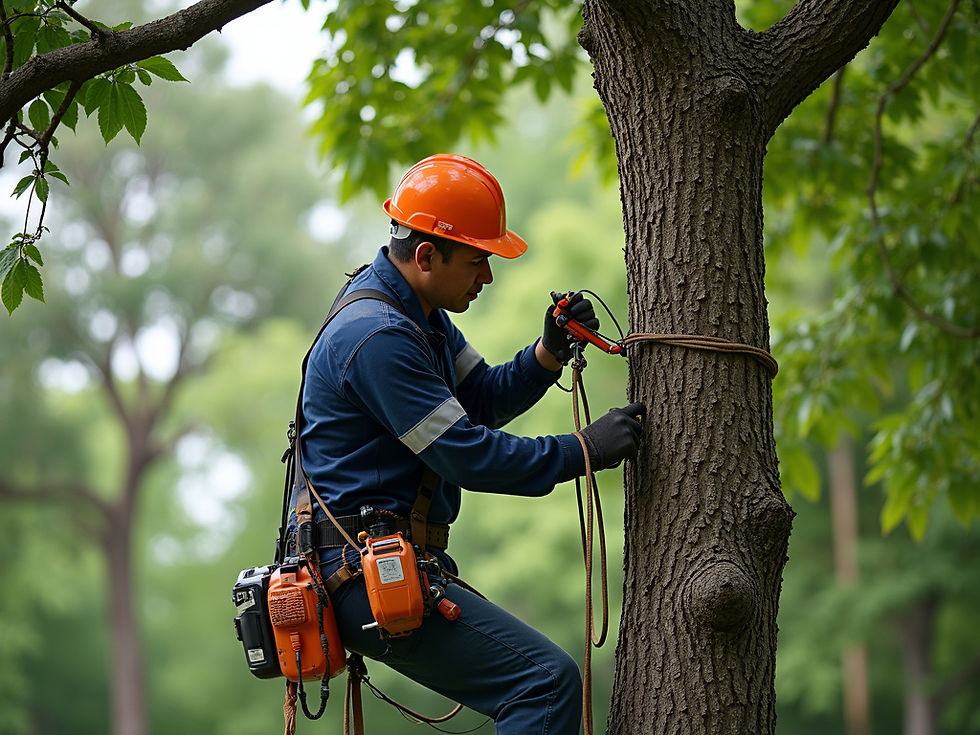
Tree work requires a high level of technical skill, training, and experience. That is why our teams are fully trained and competent, ensuring every project is carried out safely, professionally, and with minimal disruption.
Below are the key services that form part of our tree management work.
Tree Felling
Tree felling involves removing a tree in a single operation. Where necessary, we also carry out sectional felling, carefully dismantling the tree in sections when space or safety requires it.
Every tree must be felled safely and in a controlled direction. We carefully consider surrounding trees, nearby structures, the tree’s lean and height, and the slope of the ground before undertaking any work.
Tree Reductions
Tree reduction reduces the overall height and spread of a tree while maintaining its natural shape. This helps keep the tree healthy and improves its appearance.
Reducing a tree can also allow more natural light into surrounding areas while maintaining the tree’s structure and balance.
Tree Planting
We provide professional advice and services for planting young trees and saplings. Our team can help you select the most suitable species and location, ensuring the new tree thrives in its environment.
We also identify and address any potential issues that may affect or be affected by the planting of a new tree.
Crown Reduction
Crown reduction involves the removal of dead, dying, diseased, weak, or overcrowded branches. These branches are pruned back to healthy growth points to improve the tree’s structure.
This process reduces the overall size of the tree while maintaining a balanced and tidy shape, often making it a better alternative to removing the tree entirely.
Stump Removal
After a tree has been removed, the remaining stump can be an obstruction and may even begin to regrow.
We use stump grinding to quickly and efficiently remove the stump, leaving the area ready for replanting, landscaping, lawn restoration, or driveway installation.
Deadwood Removal
Dead or decaying branches can pose a risk to both the tree and the surrounding environment. Removing deadwood improves the overall health of the tree and reduces the risk of falling debris.
This process is often carried out as part of crown reduction or crown thinning, particularly in gardens, public spaces, and areas where safety is a priority.
Crown Thinning
Crown thinning involves selectively removing live branches to reduce the density of the tree’s crown.
This allows more light and air to pass through the tree, improving its appearance and increasing its ability to withstand strong winds and storms.
Storm Damage
Storm-damaged trees and branches can be extremely dangerous due to instability and structural weakness.
Our qualified teams safely remove damaged branches and trees using specialist climbing and lowering techniques. If a tree is too unstable to climb safely, we may use a cherry picker or MEWP (Mobile Elevated Work Platform) to ensure all work is carried out safely and in accordance with health and safety regulations.
Tree Condition Survey
If you are responsible for trees on your property, a tree condition survey can help ensure they are safe and properly maintained.
Our professional tree inspector will assess each tree for structural defects, disease, decay, or weak branch unions. Following the inspection, you will receive a detailed report outlining our findings and recommending any necessary work to reduce risk and liability.
Your report will also include a detailed site map showing the location of each tree.
Landowners and property managers have a legal responsibility to ensure trees are maintained in a safe condition under the Occupiers’ Liability Acts 1957 and 1984. Commercial property owners also have obligations under the Health and Safety at Work Act 1974 to regularly inspect and manage trees to prevent foreseeable risks.
Government guidance, along with advice from the Forestry Commission and the Arboricultural Association, recommends that trees are inspected regularly by a qualified professional. Failure to do so could result in liability or prosecution should damage or injury occur.